

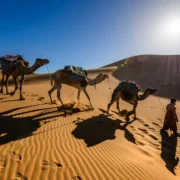


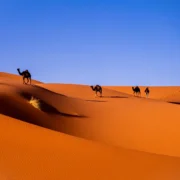
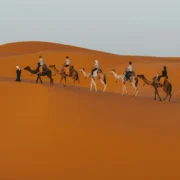


This is the journey of the old caravans: from the palm groves of Zagora in the Draa Valley, east across the open Sahara to the golden dunes of Erg Chebbi in Merzouga. For eight days you walk with your own camels and a team of nomad cameleers, crossing dunes, stony hamada, dry riverbeds and hidden oases far from any road.
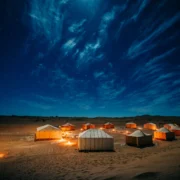
Along the way you meet nomad families at their wells, rest in the remote oasis of Tafraoute Sidi Ali and sleep every night under one of the clearest skies on earth. Your private driver takes you from Marrakech to Zagora at the start, and the trek ends with sunrise over the high dunes of Merzouga. It is a slow, silent and unforgettable way to discover the real desert.
Day 1: Marrakech to Zagora via Aït Ben Haddou and the Draa Valley
Your driver picks you up in Marrakech and crosses the High Atlas over the Tizi n’Tichka pass. Visit the UNESCO kasbah of Aït Ben Haddou, then continue through Ouarzazate and Agdz into the Draa Valley, the longest palm grove in Morocco. Dinner and night in a kasbah hotel in Zagora.
- Driving time: about 7 hours 30 minutes with stops
Day 2: Zagora to the Tinfou Dunes – Start of the Trek
Meet your cameleers, load the camels and start walking south through the palm groves and earthen villages of the Draa. In the afternoon reach the first golden dunes near Tinfou. Sunset from a dune, dinner cooked on the fire and first night in the bivouac.
- Trekking time: about 5 hours
Day 3: Along the Draa Valley
Follow the dry bed of the Draa river between acacia trees, palm oases and old ksour, where farmers still grow dates and barley. Lunch in the shade of the palms and night in the bivouac near a village well.
- Trekking time: about 5 to 6 hours
Day 4: Leaving the Draa for the Open Desert
Turn east, away from the river, into the wide stony plains of the hamada. The landscape opens up, with distant mountains and small dune fields on the horizon. Night in the bivouac far from any road.
- Trekking time: about 6 hours
Day 5: Nomad Land
A day crossing the grazing lands of nomad families, who still move with their tents, goats and camels. Stop for tea at a nomad camp if the families are nearby, and learn how they find water and read the desert. Night under the stars.
- Trekking time: about 6 hours
Day 6: The Oasis of Tafraoute Sidi Ali
Walk through sand and dry riverbeds to Tafraoute Sidi Ali, a remote oasis village surrounded by dunes, a traditional stop for caravans between the Draa and the Tafilalet. Refill water, rest in the shade and meet the villagers. Night in the bivouac near the oasis.
- Trekking time: about 5 hours
Day 7: Dunes and Dry Lakes
Continue east across small dune fields and dry lake beds where mirages shimmer in the heat. A long lunch break while the camels rest, then an evening of stories and music around the fire.
- Trekking time: about 6 hours
Day 8: Black Stone Plains towards Ramlia
Cross the black stone plains of the eastern Sahara, with fossils at your feet, towards the area of Ramlia and Taouz. In the evening the first outline of the great dunes appears on the horizon. Night in the bivouac.
- Trekking time: about 6 hours
Day 9: Arrival in the Dunes of Erg Chebbi
The last stage leads into the high golden dunes of Erg Chebbi. Climb a dune to watch the sun set over Merzouga and celebrate the end of your journey with a farewell dinner and Berber drums at a desert camp, with a hot shower at last.
- Trekking time: about 5 hours
Day 10: Sunrise over Merzouga and Departure
- Eight days on foot with camels across the Moroccan Sahara
- From the Draa Valley palm groves of Zagora to the dunes of Merzouga
- The remote oasis of Tafraoute Sidi Ali and the land of the nomads
- Seven nights in a bivouac under the stars
- Sunset and sunrise over the high dunes of Erg Chebbi
- Camel trekking means walking most of the day beside the camels, with the option to ride when you are tired. A normal level of fitness is enough; the pace is slow and there are long breaks in the shade.
- Nights are spent in a simple nomad bivouac: tents or mattresses under the stars, with blankets. There are no showers on the trek days, but water for washing is provided.
- All meals on the trek are cooked by your cameleers on the fire: bread baked in the sand, tagines, salads, fruit and endless mint tea.
- The best months are October to April. Summer days are very hot, so long treks are not run from June to August.
- Bring a sun hat, sunglasses, sun cream, a headlamp, good walking shoes and a warm layer for the night; we provide a Berber scarf.
- Prices depend on group size and season. Contact us for a personal quote.